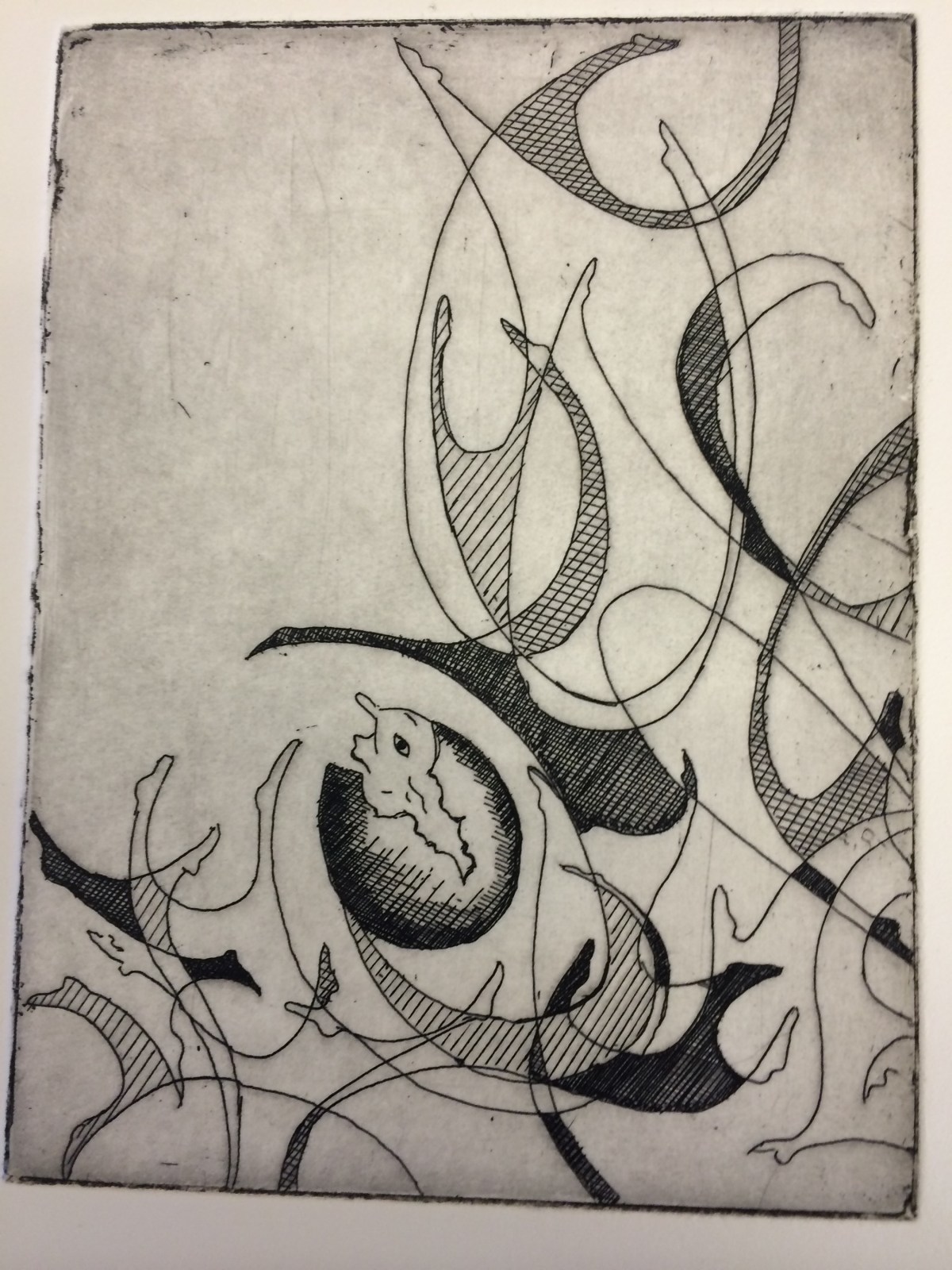
Painful Love

They scraped away the seagull nest on the building across from mine. I was going into the kitchen when I noticed him, the maintenance man up on the part of the roof that no one had ever been on before. He stared at the green mound and then kicked it with the toe of his boot. 

I’m not unaware of the difficulties associated with seagulls. I’m also not unaware of the difficulties associated with humans. We’re the ones who removed the trees, toxified the water sources and put plastic into the mainstream animal diet. Compared to that, I think a few issues with seagull feces are relatively minor. 

The pair of seagulls who’ve nested on that site have been there for at least eight years. We’ve watched them take turns, never leaving the eggs alone. They’ve warded off eagles and annoyed a few humans who wanted to smoke on the roof. One of the most hateful grabbed a two-by-four and tried to strike the protective seagull down. Of course, I was yelling and gesticulating wildly in my unit across the street, wishing for a zip line over there so I could give that man a piece of my mind. 

Every year we name the babies. One year I was especially worried that something bad would happen to the sole fledgling and I named her Fly, in hope that it would be a prophecy of sorts. Usually baby seagulls take time to figure out the whole flying business. The babies hop-hop-hop and flap their wings. Then they graduate to short trips around the roof before taking off after one of the parents, toward the Puget Sound. Fly skipped all the steps and went successfully and directly to full and comfortable flight. She looked around as if to say, “Yeah. I was born for this.”  

Some years there have been three babies, and then I focus extra prayer on the underdog. One is always dominant, then there’s the head honcho’s buddy, and then there’s the free spirit. S/he’s typically a little more submissive. I worry about that one the most. But every year since we moved here, we’ve never lost a baby. I know it’s the same pair of parents, too, because the papa has a gimpy foot. 

Seagulls are loyal, protective, and downright beautiful. I love them. I actually love most all of the animals. I can’t help it. I love the plants, too. I’ve been known to hug a tree. 

Someone once said to me that if she loved all the animals as much as she loved the humans, she wouldn’t know what would happen to her. In the context of the conversation I think she was assuming that I, therefore, must not love humans very much. For the record, I do love humans. The fact that I’m infinitely grieved by the ways in which we selfishly despoil environments across the globe in our constant battle for economic supremacy notwithstanding, I love humans as individuals. I have many friends. I love my students, coworkers, and even my dear and difficult family. I guess then, that I am evidence of what happens to a person who can’t help but love with abandon. 

I can hear the groaning of the earth, feel it shift in discomfort under my feet. When I hold a baby rabbit, which is one of my favorite things in the world to do, I am at once delighted by the sweet and vibrant life in my hands. I treasure the ears, the twitching nose, and the big thumper feet. Simultaneously I am deeply saddened because I know that this tiny life is fragile. Everything eats rabbits. They aren’t known to be hardy. It is guaranteed that this one precious life will suffer pain and cry out in fear. There is no way of guaranteeing otherwise. It’s the way of earth, as it is, and I do not believe it is as God intended. It’s a product of human intervention, and God’s way of compensating. Every time I see a freshly developed construction site, with its felled trees and uprooted daisies, I grieve. 

Now, the point of this is not to say, “Poor me. How unfortunately perceptive I am.”  The point is that there is a price to love. The truth is, every time we love anyone or anything we are opening ourselves to loss and pain. Those of us more inherently in tune with the natural world are perhaps most aware of this, because loss is so frequent. Nevertheless, it’s true for all. Some losses are more painful than others. My little white cat keeps nuzzling my hand while I write. Assuming she dies before I do, I will be wrecked. 

That’s how I feel about my seagulls. If they rebuild the nest and maintenance decides to destroy it again and kill the babies I will be absolutely beside myself. I’ll probably have to take off of work. I think we may have to say goodbye to them and move, just to protect my sanity. 

So yeah, I love just about everything and I deal with depression and anxiety. There are other reasons for this, of course, but my big love (for which I can’t claim credit, having been born this way) plays a part. Here’s the thing, though. I wouldn’t change it if I could. I can’t bear the thought of not appreciating all that is wonderful in the world, including you, even if it means I have to pay in the end. 

I’m hoping I got this from God. I’m hoping he feels like this, too, and that somehow he’s going to make everything right. I’m banking on it, because if Love is the source of the universe, s/he’s not going to bear suffering forever. Someday she’s going to say “enough,” and all the rabbits and the seagulls will be fearless. And selfishly, the ever-ache in my heart will be gone. Until then I will groan with the world and keep learning to love more selflessly, because it’s the only reason to live. 

Invisible Stars

Poetry by its nature requires a great deal of revision before it’s very good. Blogging, however, is sort of like a diary. It’s more of a stream of consciousness kind of genre. I know this, and yet I’m still including poetry here. I don’t claim it’s great. It’s just how my mind works. Sometimes my own mind needs to word things this way so that I can understand myself. If I think it’s worthy I’ll spend more time on it later. If not, it’s just a window into my way of thinking. So here’s the latest thought:

I cannot see the stars from
here in the city
town down from midnight
clouds and buzzing human
thrum. 

I feel the moist in the best
nights, softening the noisy
edges and spreading thick on
my twelfth floor leaves but no,
I cannot hear them. 

They all do their best and I
love them for that. They’re simply
come-over by industry, business 
and thrall. 

The invisible stars meet the
silent leaves and shimmer
in the mist. But my love is
too small, too much on
my self. 

I need to be surrounded, and
not with people
(though some are special and 
keep me alive). I need to hear the
wind-singing cellulose,
flying shadows under the
moon with untidy green beneath,
breathing kinetic sculpture into
the ground. 

The invisible stars hum just 
the same. But I am too deaf
to hear them. The dancing toy
trees keep their beat, but 
my heart is too far to
join them.

Tree Hugger

I spend a lot of time at home alone, especially in the evenings. My husband has his own business and it often requires that he meet with his clients after their work hours. I don’t particularly mind. I’m an introvert and I often have papers to grade while listening to a TV mystery in the background. It’s one of the more mysterious aspects of my character that I’m a vegetarian who’s been known to save worms off the sidewalk, but I don’t mind murders or shootings on television. We’ve finally chalked it up to the years of vivid nightmares I’ve had. So as long as all the animals are okay on television, so am I.

Anyway, I’m here at home alone, looking out my window at a sea of other city windows. Seattle is currently the fastest growing city in the U.S., and I can tell just by the number of cranes within my field of vision. It’s pretty cool, all that life out there, throbbing and pulsing over the pavement. We have easy access to public transit, we’re centrally located, and I believe in the importance of urban densification. I have to admit though, that I really miss trees, and songbirds, and flowers. I don’t miss grass. I mowed lawns for my father’s landscaping business for seven years as a kid. Grass requires a lot of water and toxic herbicides and constant mowing using equipment that generally runs on fossil fuels. You can keep your damn grass. But I do miss trees.

In a purely spiritual way I don’t fully understand what it is that makes trees so special. Even an artist-type like me sees the scientific benefits such as oxygen production, carbon sequestration, and prevention of soil erosion, but that’s not why I have a visceral connection with them. They do change colors with the seasons, and that resonates deeply with my sense of the passage of time. They provide shade, and not the flat, achromatic shade of man-made structures. Their shade is alive, dappled and musical, just like the wind in their leaves.

I was walking across campus the other morning, the first morning when the temperature hit freezing. The massive chestnuts and oak trees on our campus loop had starting shedding their leaves like flower petals at the end of their blossoming. Great, golden snowflake-petal-leaves drifted steadily down to the constant whispering of their own departure. A shard of sunlight lit strips of them in radiant, visual song. I will hold that vision always, as a meeting with something divine. God was there in that moment and so was I, becoming just by being there, more of who I truly am.

One of the greatest of our campus trees was removed while I was away one summer. It was dying of old age, creating a potential hazard for students. I have grieved its loss ever since, as I have also grieved for the sweetness of the old cherry tree outside my classroom window. I used to stand still under its blooming branches and stare up into all its glory. Petals were under my feet, and dancing overhead. They made the sky soft and if I’d been the weeping kind, I would have wept under that tree. Sad and happy and lifted from mundanity into a perfectly reasonable suspension above earth, I would feel hope on my worst days.

Environmentalists are often referred to as tree-huggers in a confusingly disdainful way, as though hugging trees were some sign of dementia. I’ve never been offended, personally, taking it as a reference to sensitivity. While being sensitive can be painful, I’d never trade it for a more comfortable disconnection.

As I’ve been teaching this quarter about the connection between environmental care and faith, I’ve been thinking a great deal about Saint Francis. I don’t know very much about very many saints, I must admit, being raised a fundamentalist evangelical; that’s fodder for a different blog entry. I have heard of St. Francis, though, and I love him. Reportedly, he’d go out into the fields and preach to the birds and the trees. “Sing!” He’d proclaim to the birds. “Sing what’s in your heart and be fully alive, yourselves. In doing so you praise your God.” And “Clap your hands, you trees! Bear your fruit and your nuts. Grow bark and rustle leaves and dapple the ground with everything you were made to be! You bring worship to God who made you!” The townspeople generally thought he was nuts, but I love that man. He speaks my heart from the past and tells me that yes, God is in the trees. And to all you theologians out there, no, I don’t believe he’s limited to being a tree although I do think he could inhabit a tree as easily as he inhabits any human. Trees bring a unique representation of his character to life. They reveal his love, his beauty, his constancy, and his ever-changing breeze.

One day I’m going to look out the windows of my home and see trees that don’t look like children’s toys. I will hear their leaves speaking to me, and I will feel that deep sense of serenity their voices bring. For now, I’ll be an unabashed tree-hugger on campus. I could hardly be a good example to my students if I weren’t. I could hardly be myself.