Mulch

Well, I’ve spent two days doing absolutely nothing. I brought grading home and it needs to be done, but there it sits on the kitchen counter. I suppose I can give myself some credit for watching television that won’t bring me any nightmares, but I do wonder about the animal welfare oversight in “Milo and Otis.” And in my own defense, I started getting an earache and sore throat, and the best way to fight these things off is to rest. Which brings me to the inevitable question of why I need to defend rest. What is it that makes me feel guilty for being a little self-indulgent for a couple of days. It’s not as though I’m irresponsible and continuously self-absorbed.

When I was growing up I worked for my dad from the age of 11, mowing lawns after school and on weekends. He pulled me away, crying, from a friend’s birthday party and said, “Do you think I want to work this hard?! No! I taught all day and I’m tired and I’ll have homework to grade when I’m home.”
That came after “If I’d had a boy, he’d do it. But I had a girl, so you’ll have to to do it instead.”

It wasn’t his greatest hour. Now that I’m grown I know he was working three jobs, had an unhappy childhood and was in full avoidance of all his grief about my mother’s unexpected disability. Being buried in work was part of how he coped with emotions he didn’t want to face. His hair trigger temper and general unhappiness were understandable, but I was 11 then, and all I felt was that I didn’t matter. My feelings didn’t matter. My heart didn’t matter. I wanted to please him so badly, to make him look up from his work and smile. I never succeeded, but that was always my goal. So I thought the very least I could do was learn how to work, and work hard. I didn’t want any special treatment because I was a girl. I lifted lawn mowers, hefted bags of clippings and mowed up and down hillsides without complaining.

People always ask if he paid me, as though that made any difference at all when I was 12 and had no say in what I did or didn’t do. For the record, he did pay me. He found it to be a great opportunity to teach me how to handle money and pay my own expenses while being able to write off his payments as business expenses. It was quite clever, really. I learned how to be responsible and hard-working. I learned how to take initiative, keep my head down, and my mouth closed. I learned all about hard work.

Really though, there are plenty of people who have a hard time not feeling guilty about taking time off, who haven’t had the same upbringing. Perhaps it’s something about being American, a sort of “forging west, doing your part, pulling up the old bootstraps” kind of thing. We take fewer vacation days than almost anywhere in Europe. It seems like we feel like better people if we work hard. We don’t want to be slackers, or unmotivated.

Maybe it’s something to do with our sense of impending mortality. We don’t want to waste time. But what ramifications does that have for people like my mother, whose disabilities preclude the possibility of employment? Is her life worthless or meaningless? And what about people like myself, who can work but have emotional and related physical limitations that require them to occasionally stop completely to recharge? Are these necessary down times wasted? I admit I’ve often felt like it.

When I was small, I was a dreamer. I was only ever in trouble at school for looking out the window and dreaming, or getting caught up in natural wonders on my walk to school and being late. It seems like wasting time is almost intrinsic to who I really am. I think and feel deeply, and those dreamy times have sometimes brought a sense of spiritual connection or a momentary release from the pressure of dealing with all the practical burdens of life. This release can sometimes lead to inspiration or creativity. But here again, I feel myself pandering to the need to justify rest.

What if rest justifies itself? Even God has been said to rest, which according to the Judeo-Christian way of thinking means it can’t be bad. What if it’s a gift to have time just to be? We are not, if we admit it, fully defined by what we do. Yes, our actions provide proof of our character, and tangible evidence on which we can base our evaluations of others. It is not, however, everything that we are. I’m not just a professor, or a writer, or a beginning artist. I’m not just a former musician. All of these things are definitions based on things I’ve done. I am something more than all of that in my heart.

What I cannot escape is that this essence of my being, this ephemeral spirituality that exists outside my physical parameters, my innermost “me” requires expression. The other day I sent something I wrote to a friend and said, “It’s as though what I write does not exist unless I share it.” Similarly, it’s as though my self does not exist unless I share it. Sharing requires activity, which is sometimes work. Being and doing seem to be inescapably intertwined. And yet, being and doing exist in time, and nature itself suggests there are seasons for everything, laying the groundwork for new life. For myself at least, being must precede doing if the subsequent actions are to be meaningful. And resting helps me connect with that being, so everything I then do is a more accurate representation of who I really am. Being must be the source of my doing, or else I’m merely engaged in frenetic activity of little depth. So basically, the fact that I’ve been sitting on my ass for two days straight is an action itself of immense importance. It is a form of doing. It’s the mulch of fall leaves and the hibernation of winter. Spring will come soon enough, with plenty to do. Hopefully that doing will be more than me leaning in and keeping my head down. Hopefully it will be an expression of my heart.
Tomorrow

Tomorrow I will grade. 
Tomorrow I will go to the drug store. 
Tomorrow I will shower and dress and walk around on my feet as though I know what they are for. 
Tomorrow I will laugh when I hear something funny. 
Tomorrow I’ll make love, write cheerful Christmas cards, post something meaningful to my blog. 
Tomorrow I’ll find God, or she’ll find and fix my me.
Tomorrow I’ll realize my me is fine maybe today maybe
yesterday was alive yelling
“Fire!” in her own crowded
building because something
was wrong that wasn’t 
her but at her near
her on her mind her
heart her placement in the where 
of all her time. But tomorrow I will 
open, be, and savor will for
breathing in my life and
with me seeing
keep today. 

Circular Thinking

You say this and then
feel that which makes
me this that then
does that. My this
is brave when you
say that, I fall my 
feel when you do
there. Where I go 
down you flash your
these my darling
pair I feel you leaving. 
You say stay I feel my
going with my feet 
still solid weeping. 
Loving you feels you
are saying, then I do
and lay the weaving. 
You are you and I 
feel me and then do
choose to be and free
the you in you, the me
in me, which feels like
death and life and
breathing. When we do
and feel and are who we
are made to be, believing
I can break the pattern 
strong and walk toward 
you and me apart, together
loving, honest saying you
do this and I feel that
which leads to us
and brings us back. 

Tree Hugger

I spend a lot of time at home alone, especially in the evenings. My husband has his own business and it often requires that he meet with his clients after their work hours. I don’t particularly mind. I’m an introvert and I often have papers to grade while listening to a TV mystery in the background. It’s one of the more mysterious aspects of my character that I’m a vegetarian who’s been known to save worms off the sidewalk, but I don’t mind murders or shootings on television. We’ve finally chalked it up to the years of vivid nightmares I’ve had. So as long as all the animals are okay on television, so am I.

Anyway, I’m here at home alone, looking out my window at a sea of other city windows. Seattle is currently the fastest growing city in the U.S., and I can tell just by the number of cranes within my field of vision. It’s pretty cool, all that life out there, throbbing and pulsing over the pavement. We have easy access to public transit, we’re centrally located, and I believe in the importance of urban densification. I have to admit though, that I really miss trees, and songbirds, and flowers. I don’t miss grass. I mowed lawns for my father’s landscaping business for seven years as a kid. Grass requires a lot of water and toxic herbicides and constant mowing using equipment that generally runs on fossil fuels. You can keep your damn grass. But I do miss trees.

In a purely spiritual way I don’t fully understand what it is that makes trees so special. Even an artist-type like me sees the scientific benefits such as oxygen production, carbon sequestration, and prevention of soil erosion, but that’s not why I have a visceral connection with them. They do change colors with the seasons, and that resonates deeply with my sense of the passage of time. They provide shade, and not the flat, achromatic shade of man-made structures. Their shade is alive, dappled and musical, just like the wind in their leaves.

I was walking across campus the other morning, the first morning when the temperature hit freezing. The massive chestnuts and oak trees on our campus loop had starting shedding their leaves like flower petals at the end of their blossoming. Great, golden snowflake-petal-leaves drifted steadily down to the constant whispering of their own departure. A shard of sunlight lit strips of them in radiant, visual song. I will hold that vision always, as a meeting with something divine. God was there in that moment and so was I, becoming just by being there, more of who I truly am.

One of the greatest of our campus trees was removed while I was away one summer. It was dying of old age, creating a potential hazard for students. I have grieved its loss ever since, as I have also grieved for the sweetness of the old cherry tree outside my classroom window. I used to stand still under its blooming branches and stare up into all its glory. Petals were under my feet, and dancing overhead. They made the sky soft and if I’d been the weeping kind, I would have wept under that tree. Sad and happy and lifted from mundanity into a perfectly reasonable suspension above earth, I would feel hope on my worst days.

Environmentalists are often referred to as tree-huggers in a confusingly disdainful way, as though hugging trees were some sign of dementia. I’ve never been offended, personally, taking it as a reference to sensitivity. While being sensitive can be painful, I’d never trade it for a more comfortable disconnection.

As I’ve been teaching this quarter about the connection between environmental care and faith, I’ve been thinking a great deal about Saint Francis. I don’t know very much about very many saints, I must admit, being raised a fundamentalist evangelical; that’s fodder for a different blog entry. I have heard of St. Francis, though, and I love him. Reportedly, he’d go out into the fields and preach to the birds and the trees. “Sing!” He’d proclaim to the birds. “Sing what’s in your heart and be fully alive, yourselves. In doing so you praise your God.” And “Clap your hands, you trees! Bear your fruit and your nuts. Grow bark and rustle leaves and dapple the ground with everything you were made to be! You bring worship to God who made you!” The townspeople generally thought he was nuts, but I love that man. He speaks my heart from the past and tells me that yes, God is in the trees. And to all you theologians out there, no, I don’t believe he’s limited to being a tree although I do think he could inhabit a tree as easily as he inhabits any human. Trees bring a unique representation of his character to life. They reveal his love, his beauty, his constancy, and his ever-changing breeze.

One day I’m going to look out the windows of my home and see trees that don’t look like children’s toys. I will hear their leaves speaking to me, and I will feel that deep sense of serenity their voices bring. For now, I’ll be an unabashed tree-hugger on campus. I could hardly be a good example to my students if I weren’t. I could hardly be myself.

Not About You

I was listening to a friend a while ago as she was talking to her mom on the phone. It was nothing out of the ordinary. It was a short, two-way conversation in which she said something about her day and answered a scheduling question. It made my heart hurt. 

I always knew I had a difficult relationship with my dad, but it’s only been in the last couple years that I’ve realized my relationship with my mother was something out of the ordinary. Don’t get me wrong. She’s a gentle person who loves me and means well. The problem is that she’s never dealt with all the pain of her past, and it’s leaked into the present in unexpected ways. She’s been so desperate for security and happiness, the hole in her has been so big, that she’s looked to her only child to fill it. She hasn’t meant to. She’d deny it if asked, but her actions are contrary to her conscious desires and in line with her subconscious ones, instead. That’s my interpretation, anyway. No one can know all the intricacies of someone else’s heart. 

I got a note from her yesterday and wisely waited until morning to read it. “Thank you for your notes, especially since we haven’t been able to talk to you for a  year-and-a-half. Could you call at Christmas?”   The tone was pained.  I wrote out a tactful reply in which I expressed empathy and reminded her that it’s only been a year and two months, although it’s probably felt longer. I told her my next step involves occasional 5-10 minute phone calls and I’ve been thinking about the holidays. I folded the paper. I sealed the envelope. And then I wanted to tear it into tiny pieces and yell, “This is not all about YOU!”  I haven’t done it, but I want to. 

I broke off verbal contact after having a friend look me in the eye and say, “Your parents are killing you.” I’d come back from taking care of Mom for two weeks. I came home to Seattle in a fog, with circles under my eyes, thinner, and with back pain. I couldn’t think clearly. Another friend described me as six feet under, even though I’d spent the week following the visit with Mom being loved and cared for by some of my dearest friends in the world, who weren’t freaked out by having me curled up in a fetal position at their feet the whole time. 

I’ve always been the dutiful daughter. Until last October I spoke with my parents for an hour or so every week on Sundays. I’ve never missed a birthday and have always connected on all the other holidays. Etcetera. I don’t want to recount all the moments of my self-proclaimed goodness. I’m certainly not perfect. 

I know how hurt my parents have been in their own lives, and even as a result of my actions. I can tell their intentions from their actual behavior. I love them. But the thing is, I cannot save them, and although they would deny it, that’s exactly what they want me to do. They’re looking to me for security, meaning, and connection as they age. They want to move to Seattle because I am here, even though they loathe big cities, cloudy weather, traffic, and getting used to new environments. But I am here. Me. I can feel the pressure building as I type. 

I am the one person with whom my mother can be real. I am the one person my father can trust. I am the one person who can bring them the most joy of anyone or anything on planet earth and they want connection with me more than anything. Except. Except when I try to tell them about my life they interrupt. They don’t want to hear it because my life is 2000 miles from theirs.  I can’t tell them about my struggles because they’re full of their own pain. We sit for an hour on Skype, often saying little or nothing, because I can’t tell them I’m moving “home” and they can’t bear to hang up. I can never speak to just one of them, or the other will be tortured and pass that pain to the other. I basically had to take a break from verbal communication because I mean both too much and too little to them. They hold me too high, and they hold me away, so they don’t really know who I am. I got a note that said,  “I’m sorry if we’ve put a lot of pressure on you, but you know you’re all we have.”  Strangely enough, that didn’t make me feel better. 

The holidays are around the corner. I’ve been thinking about them a lot, knowing how sad they are that we’re still not talking. I started sending a card every week over a month ago, hoping that would help. And then I get the response that basically says “Since we can’t talk to you, thanks for the token cards. Please (have enough compassion) to call at Christmas.”  I might have done it. I may have thought, “Gosh, I do love my parents and I know they’re sad. I think I’ll give them a call.”  The irony is that since I feel guilt manipulation at work, I feel obligated not to do so. I’ve pandered to their need for me all my life. I’m the only one who can stop it. 

I’ll probably call sometime during the holidays from my therapist’s office. I’m just so deeply grieved that we don’t get to have a natural kind of relationship in which we get to be friends and have conversations that can run in two directions. They’re wounded. I forgive them, but I grieve, and I still want to run around flailing my arms and yelling my most offensive curse words in their front yard and screaming that I am not enough. 

It’s at this point I feel the need to insert a sort of commercial break, something on a completely different level. This is an advertisement for friends. Friends rock. I have some of the dearest and most wonderful friends in the whole world, and that’s not a hyperbole.  We’d give blood for each other. People have been writing their thankfulnesses all over Facebook lately, in a way that I both appreciate and detest. I get annoyed by reality avoidance and overly positive clif-notes to people’s lives, even though what must be the larger part of my heart is sincerely happy that each and every one has something for which to be grateful. I guess I’m complex that way. So here’s my contribution. I’m unendingly grateful for genuine friendships in which we can share, and hold, and disagree, and laugh, and look really pathetic after the kind of cry for which there’s never enough Kleenex. And who knows if I’d really know enough to invest in these relationships if all my needs were met by relatives. I’d be missing out on so much diversity!  I love diversity!  It scares me if I’m around too many people who agree with me for too long. I want to be surrounded by differences that make me grow. 

I guess that’s really what I want for my parents, too. I want them to branch out, and look for meaning in places that don’t include me. I want them to know how valuable and precious they are, even without my attention. I want them to know what it’s like to have an ugly cry in front of someone unrelated, who will still think they’re beautiful.  I can’t make that happen, but I can take care of me. I can do my part in failing to meet their expectations while doing my best to meet legitimate and practical needs. I can keep loving them and holding my boundaries. I can be their daughter, but not their god, and I’m doing them a favor at that. I suck as a god!  No wonder they’re confused and disappointed. So to any of you who know my parents, knock their socks off with some big hugs. Bowl them over with affection. I’ll thank you for it later.

Wearing Kindness Like Clothes

My chiropractor is one of my most favorite people in the entire universe. If I were to meet someone from another planet I’d be enormously pleased (especially if s/he decided not to wipe out the human species because of our sheer stupidity in defiling our own environment), but that new and wondrous species would still have to compete with Dr. Abrahamson for my affections. In fact, if I were to create a top ten list of my favorite people, Dr. A would be on it.  I know. This list is so short that you may be wondering about my family values, so it’s important to point out that love is only a portion of this equation. I dearly love my entire family. However, some family members are in desperate need of therapy, and because of this I can’t really trust them with my true self just yet. I completely befuddle other family members. I say something that to me seems completely innocuous, and they look at me as though I’ve turned into a fuzzy, green dream-beast. It’s kind of hard to be myself with them, too.  I have two cousins, neither of whom I’d recognize if I met them on the sidewalk. They were known to be creative and somewhat rebellious as kids, though, so we might get along just fine.

The requirements in this particular scenario involve much more than just love. Some of my top ten favorite people are in that group largely because of their therapeutic hugs or their capacity to have stimulating conversation.  One of them has swum with the sharks in San Francisco Bay, cries at the drop of a hat and is someone who always has your back. I don’t even talk very much with another one of them, but I know in my deepest self that he cares for and accepts me deeply, and I could call him if I were in trouble. There are more, but the thing they all have in common is that they accept me as I am, and are willing to work through difficult relational moments to get to the good stuff. We don’t have to agree. 

Now, it’s true, I don’t hang out with Dr. A outside his office, but at this point I’ve spent one to two hours with him, three to four times a week, for the last eight months. Many weeks I’ve spent more time with him than I’ve spent with any of my friends.  I pay him for his time, but after all of those visits, I know that although he has to make a living and certainly earns his payment, he’s in the business of healing because he wants to help people. If I get cold in the office he brings me a fuzzy blanket, and if I’m lying down he tucks in my feet. He genuinely cares about how I feel, both physically and emotionally.

A year ago I wasn’t really sure if I believed in chiropractic medicine at all.  Then I decided to leave my comfort zone and try something new, and that’s when I went to a not-so-great chiropractor and came away with a herniated disc, three bulging ones, and radically asymmetrical hips. I admire asymmetry in so many ways, but not hips. Crooked hips cause problems. And no one really straightens them out except for chiropractors, so I had to dive back in and try somebody new. My rattling hips meant business.

I heard of Dr. Abrahamson through a friend and scheduled an appointment. I took Keith with me to his office and looked at him warily. I did that for about three seconds before knowing in the core of my being that this tall, white haired, blue eyed Scandinavian was one of the safe people. He’s one of those persons who wear kindness like clothes.

My hips aren’t as crooked any more. Going to see him makes me feel safe, and somewhere in the middle of my appointment this generalized anxiety disorder sufferer manages to relax and really breathe. And ever so slowly my back is improving. I’m just endlessly grateful for all the gifts he gives me in addition to relief from back pain. He is my friend, and he helps me imagine what a soft-spoken, empathetic father might look like. I admire him, because I want to wear kindness like clothes, too.  When I really get down to it, I think there are more than 10 people on my list of favorites. There are so many different things to admire in different people. Acceptance of others though, that’s crucial, and I want it to grow within myself. I want people to feel like they could wear their flannel pajamas around me and be perfectly comfortable. And maybe if we all work on that, our interstellar neighbors will want to be friends when they find us.

Hips

Crooked hips you used to sway
when and where I 
wanted. The high and low of
your angled invitation was
intended, my slim curves offset 
and appealing. You 
were my friends, drawing eyes that
said I was young
and pretty. Up and down, down
now you betray my time
extended, like the hands of
a broken clock, falling when
unasked, and lying to new eyes that
can not see me, for you. They see
something broken, used a while,
asymmetrical in a world that loves 
balance. But I know, you cannot
help but please, even now. Asymmetry
is interesting, complex, not for 
amateurs. Like the rest of
me, more
than simple math. 

Get Messy and Live

I feel a bit like starting by saying, “I just watched this fantastically depressing show on the BBC,” in an Emma Thompson-esque accent. It wasn’t that fantastically depressing, though. The main character dies, as does almost everyone else, so I suppose it isn’t happy. But that’s what happens to us all over time, if we’re willing to admit it.  And the main character was so very human. He made so many bad choices, and so many good ones. As a viewer of his life, I sort of loved him in the end.

I just read an article that I assigned to my freshmen, all about finding God’s will. So often I’ve been paralyzed by the thought that I’d miss it and suffer horrifying consequences, especially if I dared to think the wrong thing. That has seemed to me to be the ultimate sin. Circumstances could be forgiven, but thoughts seemed eternal, as if in their intangibility lent them to power to send me to hell. And yes, I know that doesn’t make sense. It was an inarticulate feeling and those rarely do.

The article suggested otherwise, though, affirming free will and a life process that we co-author with God. So often what I teach to others ends up being for me. I know that I think things that would shock my parents, Keith’s family, and many of my friends. And yet I find myself needing to think them, to dig through them for artifacts of things as close to truth as I can find. It’s such an irony to be looking for God in places I used to consider profane, and yet I can feel him in this process with me. It’s as though he’s handing me a spade and egging me on. It’s as though he wants me to get messy and live.

We all make good and bad choices, and there usually are consequences, but in the end I think maybe he looks at us like I did the main character in that show. He was gorgeous and horrible and selfish and noble and frail, and I loved him for all that. I saw glimpses of his heart and it was beautiful. I had grace for the rest.

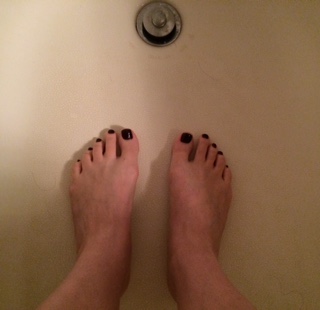
Finding my feet

I’ve become increasingly aware of the importance of feet.  They don’t get much credit for the work that they do, but I don’t get far without them.  And it’s remarkable that I can have such trouble finding appendages that are just that, attached to me with bones and ligaments, part of my physical whole.  And yet they can disappear, and I am left flat on my back without means of transportation.

I suppose this kind of thing started when I was a kid.  I questioned everything, as children are actually supposed to do at a certain point, but I was pushed back, compressed by my father’s anger that I didn’t automatically believe exactly as he’d already told me.  He was insecure.  I understand the reasons for it now, but at the time it had the effect of closing down my capacity to think for myself.  I wasn’t rebellious.  I wanted to see if I could make him happy once in a while, so I did my best.  That meant being silent, and there went my feet.  They became invisible and intangible, and I was left to stagger around all the way through part of my thirties, balancing on treacherous nubs and grabbing for handholds on reality.  I’ve got to say, that pretty much sucked.

I make no claims now that my feet are visible most of the time, that the ground I stand on is sacred.  I’m wrong a lot.  I flub and falter and fail.  I get passionate about things over which I have absolutely no power, leaving myself open to disappointment and despair.  However, I have to say, I’m not just claiming my feet.  I’m buying shoes.  Hell, I’m buying rain boots.  I’m protecting these guys, because at least when I’m standing on feet I know who I am and what I believe.  A person can’t actually make any progress starting footless where they think they should be, or worse, where others think they should be.  A person has to start moving by thinking and feeling honestly in the place where that person is actually located. That’s when the feet materialize, and that’s where I have to be to push off the ground and start to walk.

So here I am.  My feet are visible.  I’m somewhat terrified of them because I have a long history of hiding them if I sense others are uncomfortable.  That doesn’t matter, though. The discomfort is worth it.  I (and others) may cringe and groan about it occasionally, but I’m not stepping back.  These feet are taking themselves for a walk and coming out in public because the person attached to them has a few things to say.  They’re not perfect things, but they’re real and as honest as I can make them, just like my feet.  If feet are anything they’re honest, even if they’ve had a pedicure.  That just means they’re expressing themselves.

feet sm